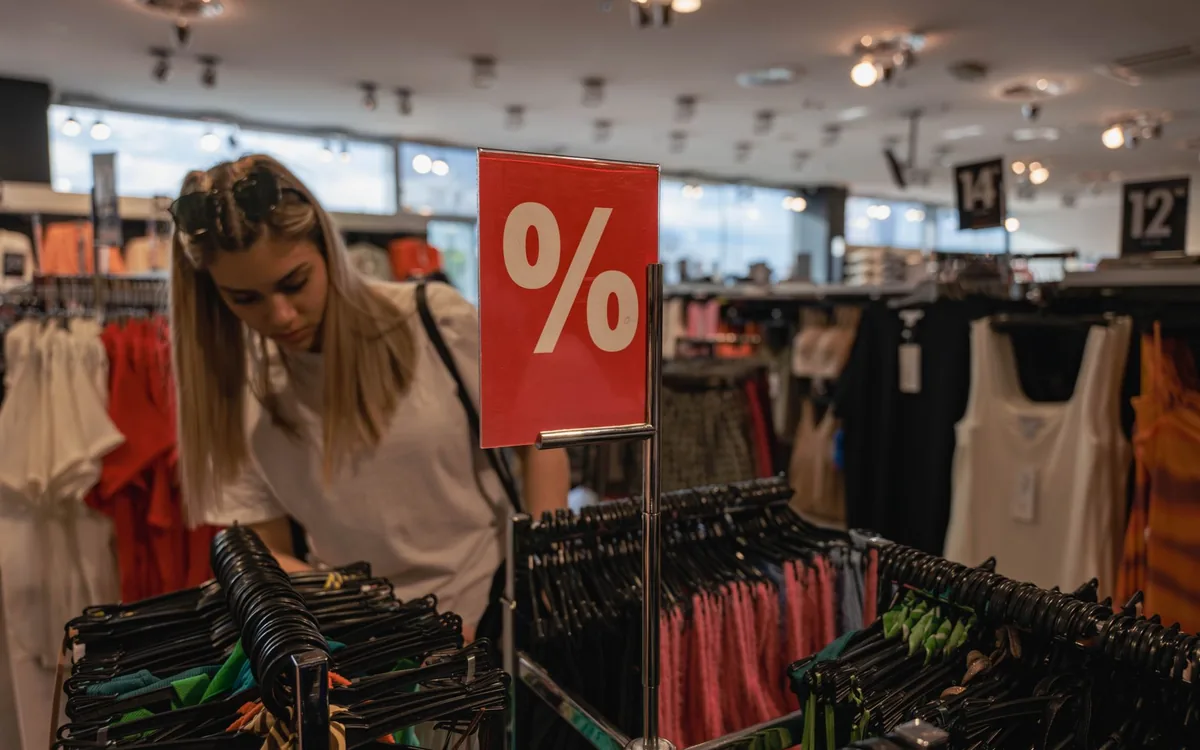
Every fashion store lives the same tension: it needs to move old stock without teaching customers to wait for the discount. Get it right and you grow; get it wrong and you become a permanent-sale shop — and a permanent-sale shop never has a full price again.
The proportion that protects the brand
Collection and looks take most of the screen loop; discount appears as an occasional piece. When discount becomes the dominant message, the customer stops seeing the store and starts seeing the price tag.
Launching a collection: what to communicate
The classic mistake is announcing “new collection in store” — information that says nothing. What moves a customer is what changed and what they can put together:
- The theme or palette of the season (“earth tones”, “linen”, “light tailoring”)
- Two or three complete looks, not loose garments
- The key piece of the collection, the one that defines the season
- The price range — a collection with no price makes people afraid to walk in
Sales: discounting without looking desperate
| Format | How it reads | When to use it |
|---|---|---|
| “Last few pieces” | Scarcity, not desperation | Broken size runs at end of season |
| “2 for X” | Volume gain | Fast-moving items |
| “Final price 49” | Clarity, no mental maths | Clearing dead stock |
| “Up to 50% off” | Weak — the customer only reads “up to” | Avoid as a headline |
| Progressive discount | Encourages a second item | End of season |
Separate the two messages in space
New collection at the front of the store and sale at the back is the standard in fashion retail — and the screen should follow the same logic. If the window screen shouts 50% off, that sets the perception of the whole store, including the new pieces.
The calendar that repeats every year
| Period | Main message | Role of the screen |
|---|---|---|
| Start of season | Collection and looks | Teach what goes with what |
| Mid season | Restock and accessories | More items per sale |
| Gifting dates | Gifts and gift cards | Suggest for people who do not know what to buy |
| End of season | Last pieces, broken sizes | Move stock with scarcity |
| Changeover | Preview of the next season | Hold the customer who would only return for the sale |
The piece almost nobody makes (and that works)
The restock notice: “that shirt that sold out is back in every size”. A customer who could not find their size will return if they know — and nobody tells them. On a screen that costs one piece and two minutes.
To turn shoppers into people you can notify later, see QR codes in store.
Announce the collection today and the sale tomorrow
Change the screen campaign from your phone, as often as you like. 30 days free, no card.
Try it freeFrequently asked questions
How far in advance should I announce a sale?+
Far enough for customers to plan a visit, but not so far that they postpone a full-price purchase. Usually a few days — announcing weeks ahead freezes sales of the current collection.
Can I mix new collection and discount on the same screen?+
On the same screen, yes; in the same piece, no. Each piece should carry one message — mixing the two confuses and devalues the new arrivals.
Percentage or final price?+
A final price usually converts better, because it removes the mental maths. Percentages work better when the original price is high and the saving is impressive in absolute terms.
How do I stop customers only buying on sale?+
By having defined sale periods rather than continuous discounting. A predictable calendar is different from a permanent promotion: the first organises buying, the second destroys full price.