Ask any restaurant owner which item carries the best margin and the answer is the same: drinks. Ask which is least offered and the answer is the same again. Dessert comes right behind. This article is about closing that gap.
Why the drink gets left out
Three reasons, and none of them is price:
- It does not appear. The menu lists drinks separately, at the end, in smaller type.
- The question is wrong. “Anything to drink?” invites a no. “Soft drink or fresh juice?” invites a choice.
- It arrives at the wrong moment. Offered after the food is ready, once the customer has mentally closed the order.
Put the drink in the same card as the dish, with a combo price. The customer stops choosing between “with” and “without” and starts choosing which.
The house drink: the item only you have
A branded soft drink is a commodity — everyone has the same one and the customer knows the going price. A signature drink (a house lemonade, a seasonal juice, your own iced tea) has no price comparison and usually a better margin.
- A name of its own (not “lemon juice”)
- A look worth photographing — the glass, the colour, the garnish
- A price positioned between the soft drink and the beer
- A dedicated piece of its own in the screen loop
Dessert: the problem is the clock
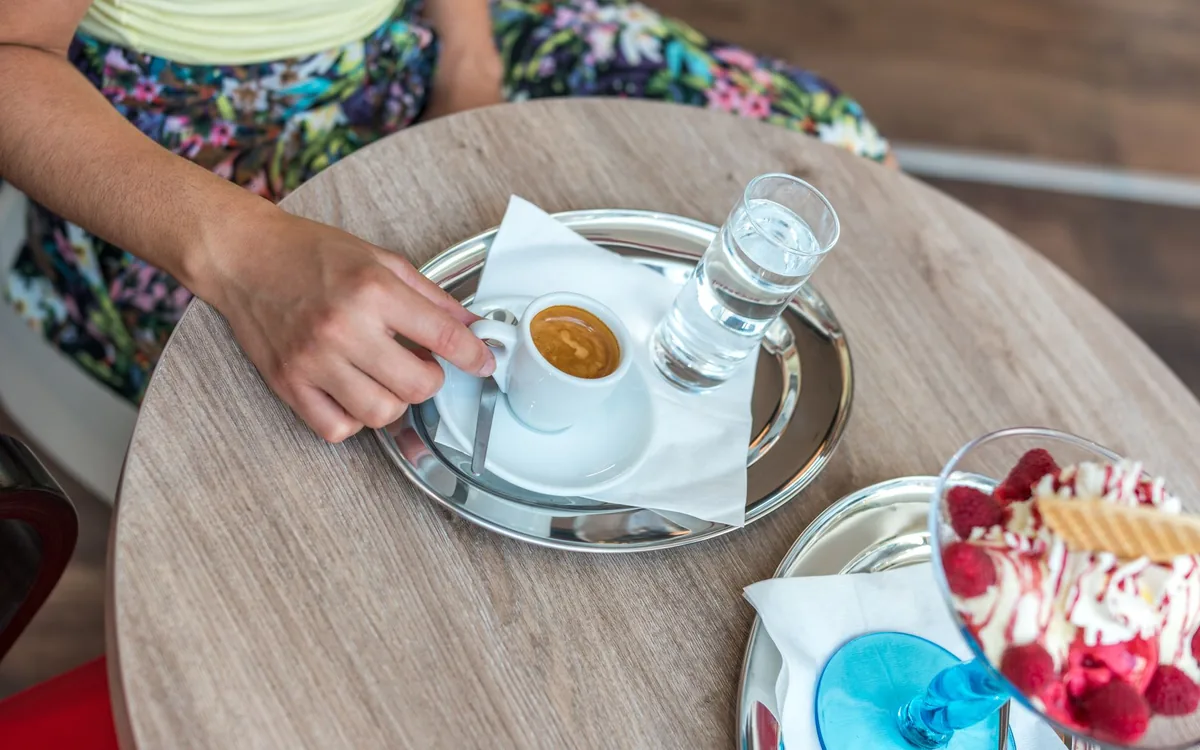
Dessert is offered when the customer is already full. That is the worst possible moment — the decision to eat something sweet forms before the hunger goes.
That is why the screen works so well here: it shows dessert while the main course is being prepared, when appetite is at its peak and the decision is still open. By the time the server asks at the end, the customer has already seen the dessert three times.
The two-dessert trick
A venue with ten desserts on the menu sells fewer desserts than one with two. Too much choice paralyses the decision at the end of a meal, which is exactly the customer’s lowest-energy moment.
| Moment | What to show on screen | Objective |
|---|---|---|
| Arrival / queue | Combo with the drink included | Get into the main order |
| Waiting for the food | Dessert in close-up, one or two options | Plant the idea before they are full |
| Mid-meal | House drink / second round | A second wave of consumption |
| The bill | Coffee, something small, counter items | One last impulse purchase |
Getting your team in step with the screen
The screen creates the desire; the team closes. If the server does not know what is playing, the offer dies halfway. Two routines fix it: tell the team whenever a piece changes, and use the same name on screen and in the server’s mouth.
If your goal is the order value as a whole, read how to raise your restaurant’s average ticket.
Show dessert while they are still hungry
Publish the piece from your phone and schedule when it goes on screen. 30 days free, no card.
Try it freeFrequently asked questions
Is it worth giving the drink away in the combo?+
It depends on the dish margin. In general it works better to price the combo with a small discount than to give the drink away — “free” devalues the item you want to have perceived value.
How do I sell dessert on delivery?+
Same principle, different channel: dessert has to appear before checkout, not after. In the dining room, that job belongs to the screen.
Do drink photos really work?+
They work when they show a full glass, with condensation, in a setting that looks like your room. Stock photography has the opposite effect: the customer can tell it is not your product.
What if my customers do not drink alcohol?+
Better still for margin: juices, iced teas and signature drinks usually have low cost and well-accepted prices, without the comparison that exists with beer.