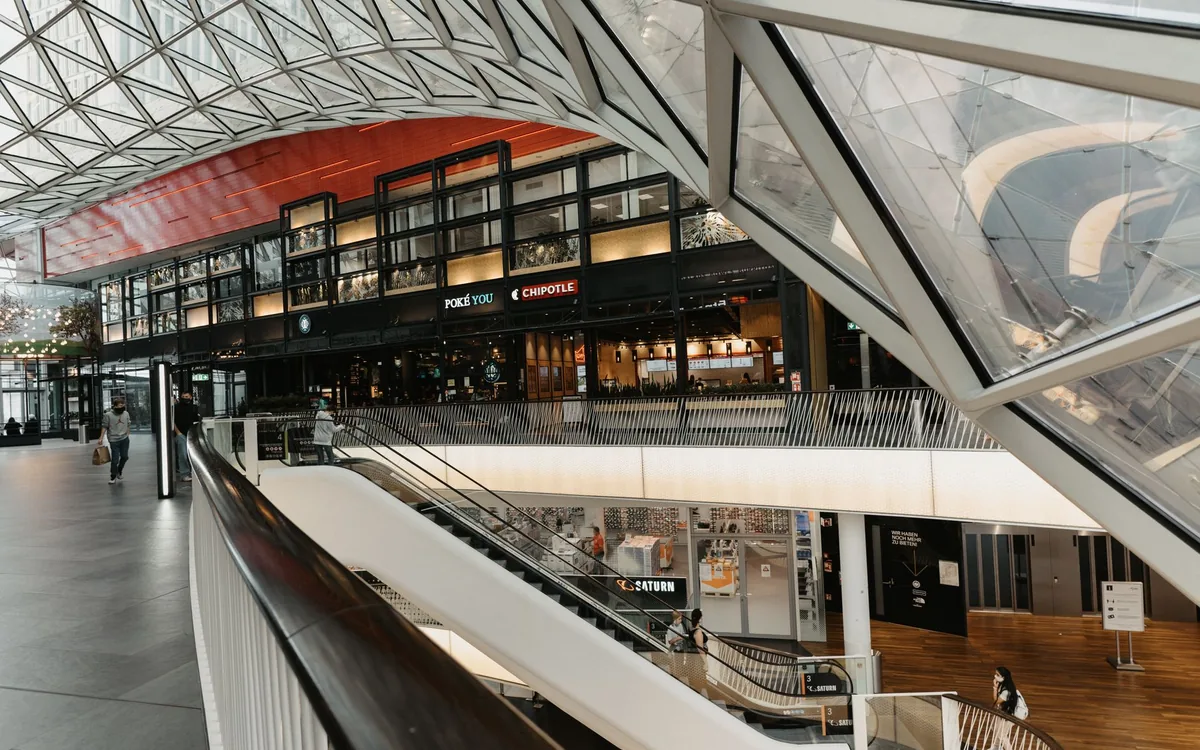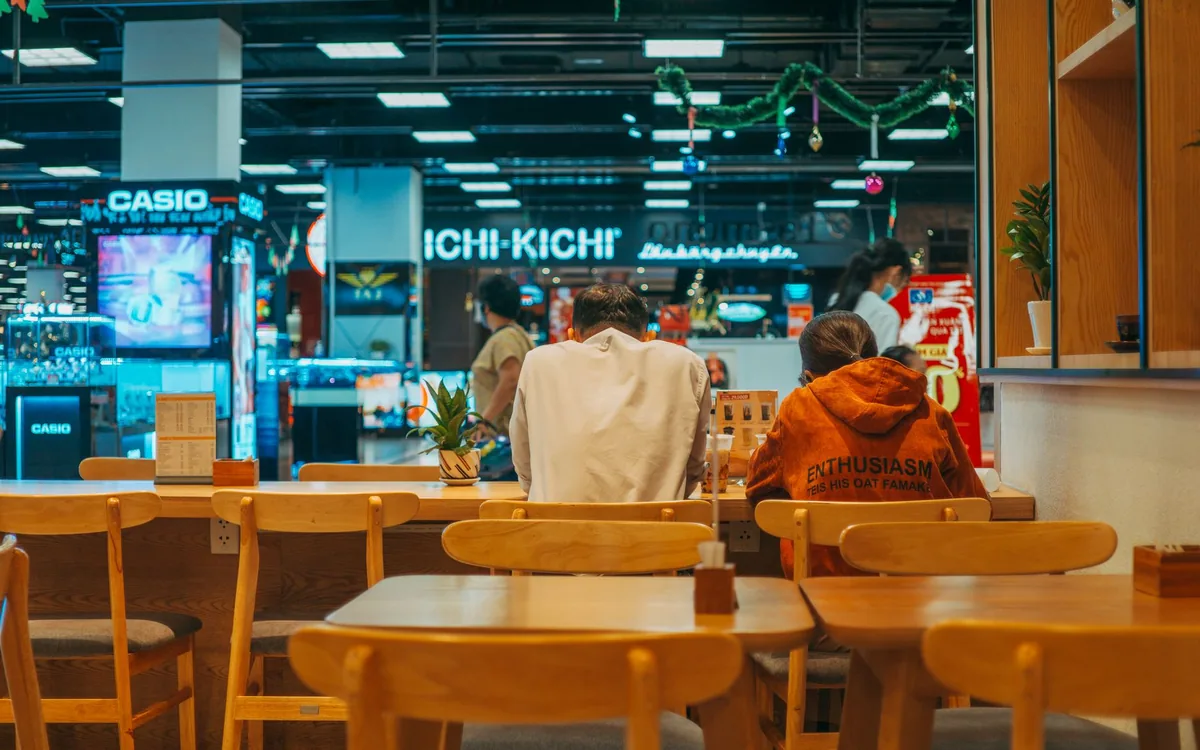
There is an enormous difference between a passing point and a dwelling point. In a corridor, people pass in three seconds, eyes on the shop windows. In the food court, they sit, eat and stay 20 to 40 minutes with their attention available.
What changes when the audience is seated
| Corridor | Food court | |
|---|---|---|
| Exposure time | 2 to 5 seconds | 20 to 40 minutes |
| Attention | Split with shop windows | Available, slightly bored |
| Ideal format | Image + 4 words | A piece with information, short video |
| Repetition tolerated | High (the audience turns over) | Low (the same people stay) |
| Objective | Pull people into the shop | Inform, create desire, convert later |
Because the audience stays a long time, a short loop repeats too often and becomes irritating. A food court needs a longer, more varied loop than a corridor — the most common operational mistake there is.
What works on a food court screen
- Offers from the food operators themselves — the audience is hungry and deciding on dessert.
- Shops on the floor above or below, which the customer would not visit unprompted.
- Mall campaigns with a deadline (a prize draw, a Christmas campaign, app sign-up).
- Light entertainment content, which holds attention between commercial pieces.
- The mall’s events and programme for the week.
What does not work
- A long corporate video on loop — people see it three times over lunch.
- A piece with small text: viewing distance in a food court is usually greater than in a corridor.
- Content that needs sound, competing with conversation and tray noise.
- An advert for a shop on the other side of the mall, with no indication of how to get there.
Time of day changes everything
The food court audience at midday (workers, short on time, quick decisions) is not the same as at 4pm (families, browsing) or at 8pm (younger, cinema-bound). Scheduling content by time band is the refinement that most increases the value of this point.
How it becomes revenue
The food court is usually the most expensive point in a mall’s inventory precisely because of dwell time. It is the flagship of the commercial proposal — and the way in to selling the other points. See how to monetise mall screens and selling media to tenants.
Use the 30 minutes the audience gives you
Schedule content by time of day on your food court screens and change it remotely. 30 days free, no card.
Try it freeFrequently asked questions
How many screens does a food court need?+
It depends on the layout and sight lines. The practical ruler is to make sure that, seated at any table, a customer can see at least one screen without turning their chair.
Should I use sound in a food court?+
Generally no. Ambient noise is high and audio annoys people who are eating. A piece that needs sound to be understood is badly built for this point.
How long should each piece be there?+
A little longer than in a corridor — around 15 to 30 seconds — with a longer total loop, to reduce the feeling of repetition.
Is third-party content (news, sport) worth showing?+
It works as filler between commercial pieces, as long as it is silent and carries no embedded third-party advertising — which is exactly the risk of using a broadcast channel.